

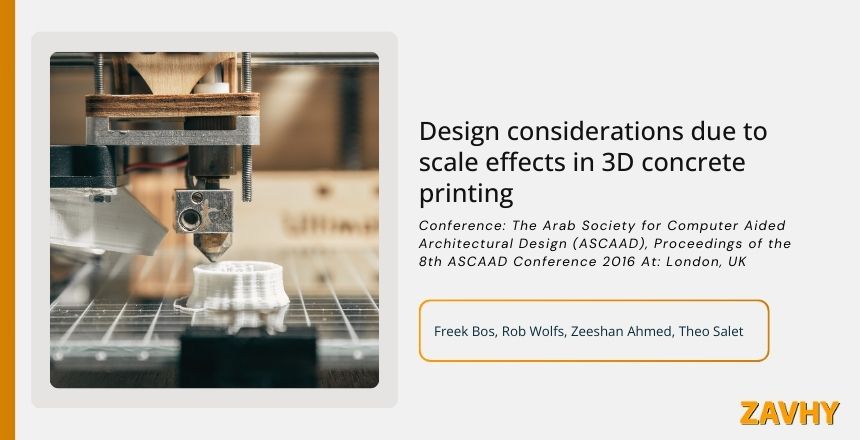
The scalability of 3D concrete printing is critically examined through the lens of designing and constructing a pavilion, highlighting the divergence between theoretical models generated by Computer-Aided Design (CAD) and the practicalities of Computer-Aided Manufacturing (CAM). This study reveals significant disparities, primarily because current CAD/CAM frameworks do not fully account for the unique constraints of 3D concrete printing, such as minimum curvature radii, which are dictated by the material behaviors during the printing process. Conversely, the adaptive nature of 3D printing can exploit these material characteristics to create complex shapes and geometries that are otherwise unachievable with traditional CAD/CAM processes.
This exploration delves into the myriad of factors that influence the transition from a digital blueprint to a tangible structure, emphasizing the non-linear relationship between the toolpath defined by CAD/CAM systems and the final printed product. Parameters such as system pressure, robot speed, nozzle dynamics, layering techniques, and overall curvature all play critical roles and vary significantly with scale. The paper discusses strategic design and manufacturing decisions that account for these scale-dependent factors, focusing on structural design, geometric accuracy, robot kinematics, and material behavior. Through the detailed analysis of a pavilion case study, this research illustrates the potential of 3D concrete printing to transcend scales and applications, from structural to architectural innovations, providing insights into optimizing design processes for large-scale implementation.