

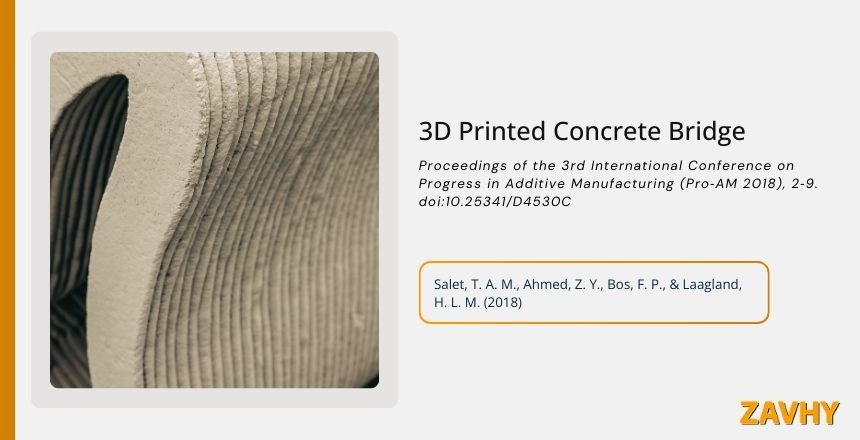
In a landmark project, industrial and academic partners in the Netherlands have achieved a significant milestone by realizing the world's first 3D concrete printed bicycle bridge. This pioneering structure not only demonstrates the potential of 3D concrete printing but also marks its acceptance in practical applications, as it received certification for safe use through a rigorous "Design by Testing" approach. This method ensured that the bridge meets necessary safety standards, with innovative reinforcement concepts incorporated to ensure safe failure behavior.
This paper delves into the comprehensive process involved in bringing this conceptual innovation to reality, including the intricate phases of design, testing, manufacturing, and assembly. The introduction of 3D concrete printing nearly two decades ago set the stage for revolutionary projects like this, pushing the boundaries of digital fabrication within the construction industry. Despite the absence of established codes for this nascent technology, the successful completion and operation of this bridge serve as a proof of concept, showcasing the feasibility and robust potential of 3D concrete printing in creating functional, real-world structures. This project not only highlights the technical capabilities of 3D printing but also its practical viability in infrastructure development, paving the way for future advancements in the construction sector.